How do you make smart decisions when the technology never stops changing?
There is a quiet panic happening inside organisations.
Leaders are being asked to invest in AI at speed, while the ground keeps shifting beneath them. Tools evolve weekly. Capabilities leap forward unexpectedly. And the cost of getting it wrong is no longer just financial, it’s reputational, cultural, and strategic.
The old model of decision-making assumed stability. You assessed, invested, implemented, and optimised. But, that model is gone now. The question now isn’t “What should we invest in?” It’s “How do we make good decisions in a system that won’t sit still?”
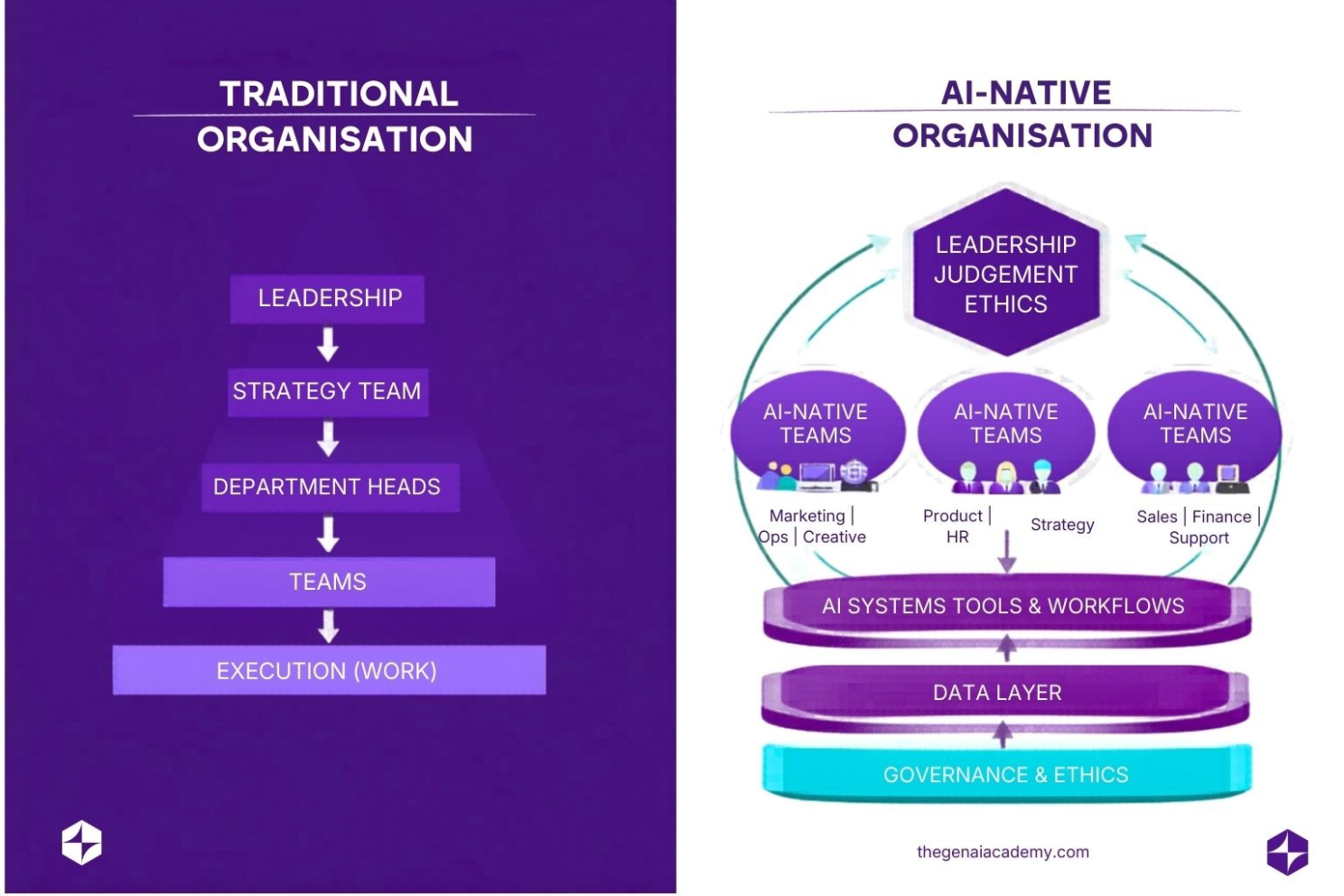
The Old Model V’s The New Model
Start Where You Are, Not Where the Market Is
Most organisations begin their AI journey by looking outward. They scan vendors, chase use cases, and build strategies based on what others are doing. But according to Rebecca Allen, that’s a mistake.
“A useful first question is one many leadership teams skip: what’s already happening inside your organisation? Scattered experiments, personal workarounds, creative use cases nobody has formally reported – this is real strategic intelligence.”
Inside most companies, AI adoption is already happening. Quietly. Informally. Without permission. People are experimenting. Solving problems. Building workflows. And leadership often has no visibility of it.
“Everything built on a clear picture of your current reality is more likely to stick.”
Before making big decisions, the smartest move is to surface what already exists. Because strategy built on assumption is fragile. Strategy built on evidence is harder to ignore.
Leadership Is No Longer About Control
Most organisations are making long-term decisions in a system that no longer behaves predictably. Leaders are no longer in control in the way they used to be. AI has significantly changed the role of leadership: AI is no longer just a tool. It is a participant in decision-making. That changes accountability.
As Dr Lollie Mancey puts it:
“The real value of leaders is now in their judgement: Good judgement now means knowing when to trust the system, knowing when to challenge it, and knowing when to override it entirely. Leaders now need to manage hybrid intelligence. Knowing when to trust AI, when to challenge it, and when human context, ethics or cultural understanding should override the machine.”
This is a shift many organisations haven’t fully grasped yet. Because AI produces answers. Confident ones. Fast ones. Scalable ones. But those answers are not always right.
The organisations that win won’t be the ones that use AI the most. They will be the ones that understand what it changes.
While Strategy Debates, Work Is Already Changing
While leadership teams are still debating strategy, something else is happening. The workforce has already moved. Employees are no longer waiting for permission. With access to generative AI, they are building their own systems, automations, and solutions.
Hugo Pinto describes a fundamental shift:
“More advanced users of Generative AI tools… will see employees creating their own AI teams, managing their own software products. If the internet democratised information, GenAI democratised the creation of Capital.”
This isn’t just productivity. It’s something bigger. It changes the nature of the organisation itself. Value is no longer created only through top-down initiatives. It’s emerging from everywhere. From individuals. From teams. From unexpected places. Which means leadership has a new job.
“The role of strategic leadership is not only mandating tools and usage, it’s also curating what surfaces to that level.”
In other words, strategy is no longer something you deploy. It’s something you have to notice, recognise, and scale.
The Real Barrier Isn’t Technology. It’s Fear.
At this point, it would be easy to assume the challenge is technical, when really it isn’t. The biggest barrier to AI adoption is fundamentally human. Fear of getting it wrong, of looking incompetent or even of becoming irrelevant and eventual job loss.
And in many organisations, that fear is already embedded in the culture.
Karrie Sullivan puts it bluntly: “The biggest mistake is not taking the opportunity to deal with fear. You can’t have trust where fear exists.”
If people are afraid, they won’t experiment. And if they don’t experiment, nothing meaningful changes. Her approach is disarmingly simple:
“ASK your early adopters 3 things in front of others: What did you experiment with this week? What mistakes did you make? What did you learn from your mistakes? Then do something most organisations fail to do. PRAISE them for experimenting and learning from mistakes in public.”
The moment people see that mistakes are safe, something shifts. Trust begins to replace fear. And progress follows.
The Risk Leaders Are Underestimating
So far, the conversation has been about opportunity and behaviour. But there is another side to this. Risk. Not abstract risk. Real, measurable, visible risk. Toju Duke is clear on this:
“Ethical AI, Governance and Responsible AI Frameworks are… essential to the success of any AI strategy. This isn’t about compliance theatre. It’s about protecting the business. Without these frameworks, organisations are likely to be ridden with law-suits, customer mistrust… decline in sales and consequently, revenue loss.”
And the risks are not theoretical. The technology is still flawed. It hallucinates. It can mislead. It can expose organisations to legal and reputational damage.
At the same time, trust is becoming more fragile. Recent backlash against AI companies over controversial decisions has shown just how quickly public sentiment can shift. Users are no longer passive. They are paying attention, making judgments, and acting on them. Which changes the nature of strategy itself.
It’s no longer just about what works. It’s about what people will accept.
AI ethics and governance are not an option. They are essential.
So What Should Leaders Actually Do?
This is where most articles give you a checklist but that would miss the point. This isn’t a checklist problem, it’s a thinking problem.
The organisations that navigate this well will not be the fastest. They will be the ones that think more clearly about what matters.
They will start by understanding what is already happening inside their business. They will strengthen judgement instead of blindly scaling capability. They will recognise that innovation is now bottom-up, not top-down. They will remove fear so people can experiment. And they will take ethics seriously, not as a constraint, but as a foundation for trust.
In a world where AI is ever evolving, the advantage doesn’t come from chasing every new tool. It comes from making better decisions about which ones are worth it.
Helena McAleer is the co-founder of TheGenAIAcademy.com . She connects organisations implementing AI with real-world experts who know how to deliver results the right way – and yes, she still uses the em dash!
Further Reading:
TechRadar The fall of OpenAI?
Springer Nature Defining Organisational AI Governance
Databricks Data, AI operations, and infrastructure form the foundation that supports organisations in fully deploying AI.
Workshops:
Karrie Sullivan – AI Adoption For Leaders
Mike Weston – AI Clarity For The Boardroom
Asma Derja – AI Ethics In Practice: From Foundations To Critical Futures
Hugo Pinto – AI: From Strategy To Action
Courses:
Dr Lollie Mancey – AI For Beginners: Through A Human Lens
& Leadership Beyond the Algorithm
Dr Eric Zackrison Ph. D. – AI‑Accelerated Strategic Planning
& Critical Thinking For The AI Era
Hugo Pinto – Build Your AI Use Case Playbook
Dave Birss – Human Skills For The Age Of AI
Toju Duke – Mastering Responsible AI
Dr Shama Rahman – Strategic AI for Team Leaders & Decision-Makers