What can leaders do when a promising AI pilot has not changed everyday work?
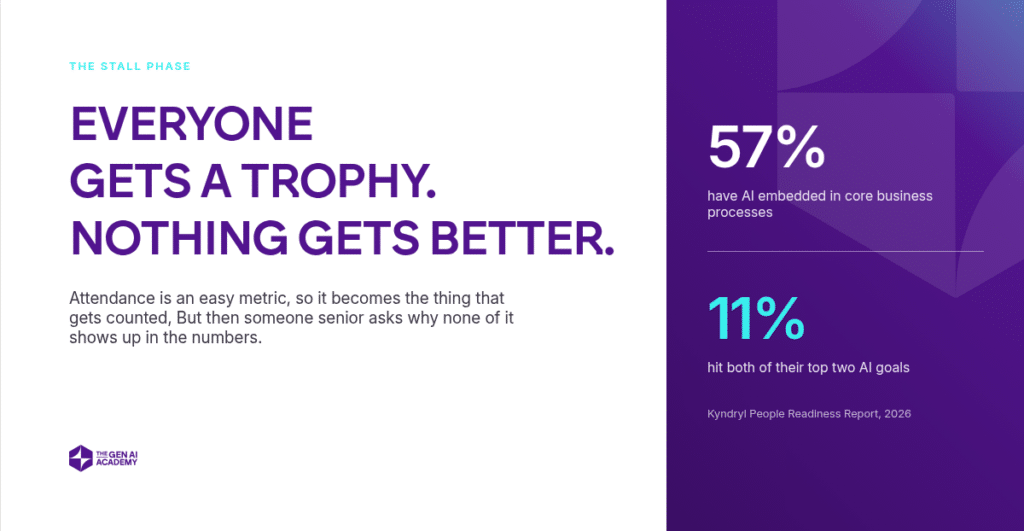
An AI pilot can look promising at launch. A few people find useful applications, training attendance is good and the tools are available. Weeks later, however, most of the organisation is working much as it did before. So, what should leaders do next when they have AI adoption challenges?
In the first episode of The Gen AI Academy’s Experiments in Artificial Intelligence podcast (22 January 2026), AI & change-management expert Karrie Sullivan spoke with The Gen AI Academy Co-founder and podcast host Dave Birss about the human side of AI adoption. Her central message is that a pilot’s early users and the wider workforce often need different kinds of support. The job for leaders today is to turn isolated experiments into better ways of working, then judge whether those changes deliver value.
Listen to the full conversation
AI Adoption That Actually Works: Meeting Humans Where They Are
Experiments in Artificial Intelligence, episode 1: “Meeting Humans Where They Are: AI Adoption That Actually Works” — Dave Birss with Karrie Sullivan.
Why Does AI Adoption Slow After A Pilot?
Karrie says that in many pilots she has worked with, only roughly 15–25% of participants continue to use the technology after the first days or weeks. That is her observation from organisational practice, not a universal rate or a benchmark every company should expect to hit. The important question is why the remaining employees have not found a useful, workable way to adopt it.
Leaders have seen similar problems with ERP and CRM rollouts: purchasing a system does not change habits by itself. AI adds another challenge because its uses are less prescribed. Teams must decide how it fits their customers, tasks and quality standards. A demonstration of what a tool can do is not yet an agreed way of working.
The first users are not one uniform group. Some enjoy exploring unfamiliar tools. Some are looking for a practical advantage in their role. Others want to understand whether AI might affect their job. Their continued use tells leaders where to investigate, but it does not prove that the same approach will work for everybody else.
Give Different Groups The Support They Need
Don’t interpret hesitation as a lack of ability. An employee who asks many questions may be trying to reduce uncertainty about expectations, security, quality or their future role. More encouragement to “experiment” may not answer any of those concerns.
Her suggested sequence begins with the people who are ready: use real work to develop and test specific applications, then show colleagues what changed. For the wider workforce, translate those lessons into role-specific process maps, checklists, examples and reusable prompts. Explain when AI is appropriate, what good output looks like and who checks it. The point is to make a useful practice repeatable rather than expecting every employee to invent one from scratch.
This is also where leaders can ask a more productive question than “Why are people resisting?”: which part of the proposed new workflow is unclear, difficult or unsupported?
Support Managers To Make The Change Work
Middle managers are often responsible for reliable delivery, customer service and compliance. Karrie argues that organisations may then ask those same managers to lead an uncertain transformation without changing what they are measured on or giving them a clear way to manage the risks.
If the leadership team wants AI use to spread, managers need time and guidance to decide which tasks are suitable, how work will be reviewed, what staff should do when an output is wrong and how the new approach affects existing responsibilities. Otherwise, calls for rapid adoption can conflict with the manager’s duty to keep the operation stable.
Measure Changed Work And Its Results
Log-ins and course completions show participation. They do not show whether a team produces more reliable work, serves customers better or has reduced an avoidable burden. Connect adoption to company strategy and monitoring outcomes such as workload, delivery quality, employee and customer experience, and retention. The useful measures will depend on the workflow being changed.
As use spreads, the risk can change too. Sullivan describes a later stage at which people may accept AI output too readily. Her example is a client proposal that sounds persuasive but promises something the organisation cannot deliver. Whether a team is at the start of adoption or using AI routinely, someone still needs to own the decision, verify the work and understand its consequences.
Dave describes a similar shift in The Gen AI Academy’s client work: organisations often begin by asking for prompting skills, then find they need help selecting workflows and developing the judgement to use AI within them. The practical leadership question is not simply how many people used a tool, but what tasks changed, what improved and who remains accountable.
What Should A Leader Do Next?
If your pilot has a small active group and little wider change, start with three questions:
- Which real tasks have early users improved, and how do you know?
- What do other employees and their managers need to use those approaches safely and consistently?
- Which outcomes and quality checks would tell you that the new workflow is better?
The answers may point to different actions for different teams. They also provide a clearer basis for deciding whether to expand the pilot, redesign a workflow or invest in more targeted support.
Explore The Episode And How The Gen AI Academy’s Support
For organisations moving from early experiments towards wider capability, the AI Adoption Programme begins with an assessment of the organisation, then develops leadership and internal capability and reviews progress. The episode explains why that work needs to begin with people and their existing ways of working.
Karrie Sullivan’s Psychology-Driven Strategies for AI Adoption course and AI Adoption For Leaders workshop explore her approach in more depth. Add verified links to the course, workshop and Karrie’s expert profile before publication.
Listen to the full conversation above for Sullivan’s discussion of workplace culture, bias, employee concerns and the future of decision-making.
Further reading
AI Has a Participation Trophy Problem — Helena McAleer explains why training attendance and positive feedback may still leave day-to-day work unchanged. This article looks at what leaders can do after a pilot reaches that point.
AI-First May Be the Worst Approach to AI — Dave Birss examines the leadership decisions behind an AI rollout and why licences or usage targets alone do not amount to a strategy.
Scaling Human + Gen AI Collaboration — Karrie Sullivan’s resource explores change psychology and how to approach different groups across an organisation.