If your team has been experimenting with AI and everyone’s building their own thing. If they’ve sat through training sessions and left with skills they can’t quite apply. If what you actually want is an AI tool your whole team helped build, understands, and uses every day, then this programme is for you.
Most AI training creates individual capability. This programme creates something better: a team that has built something together.
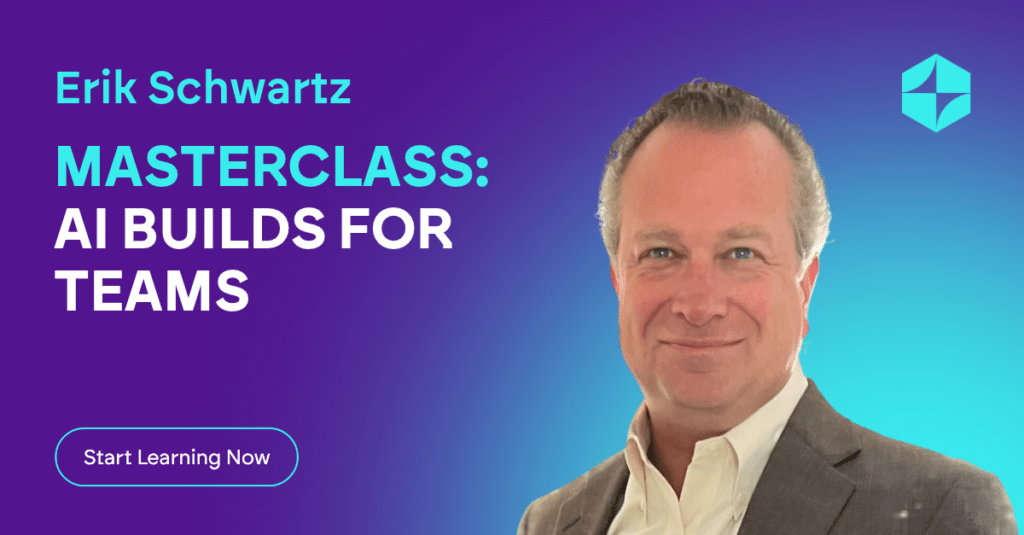
Over five sessions, Erik Schwartz guides your team through the full arc from identifying a shared problem to shipping a working AI tool, one that belongs to everyone because everyone shaped it. This isn’t theory, and it isn’t a demo. It’s hands-on building, with your team, around a real challenge from your own working world.
The programme came out of a clear gap: teams were leaving AI training energised but fragmented, everyone with their own tool, none of which worked for the wider team. This solves that. By the end, your team won’t just have an AI tool. They’ll have a shared understanding of how to think with AI, a working prototype they built together, and the confidence to keep building.
Every session is practical and participatory. You’ll leave each one with something concrete: a decision made, a design agreed, a version shipped, not a concept to revisit later.
Important Details:
Session Duration: 90 mins × 5 sessions, ideally one per week
Format: Virtual
Team Size: Min 6 — Max 20
Where does friction live in your team?
Before anything gets built, the team maps the problem. What slows everyone down? What tasks are done inconsistently, duplicated, or avoided altogether? Erik facilitates a structured session that surfaces the shared friction points and helps the team agree on the one problem worth solving and realistic in scope, meaningful in impact.
Outcome: A clearly defined team problem and a shared brief for what an AI tool could solve.
What does the tool actually need to do?
With the problem agreed, the team designs the solution. This isn't a technical specification, it's a working conversation about users, inputs, outputs, and what good looks like. Erik guides the scoping to make sure what the team wants to build is achievable, useful, and genuinely fits how they work.
Outcome: A scoped tool design the whole team has shaped and signed off on.
Hands on time, Everyones involved.
The first build session. Erik leads, but this isn't a demo. the team is in it throughout, making decisions, testing assumptions, and seeing the tool take shape in real time. By the end, there's a working first version. It won't be perfect, but it will be real.
Outcome: A working prototype the team has built together and can begin testing.
Fix what broke. Add what's missing.
After a week of using the prototype in real work, the team comes back with honest feedback. What worked? What didn't? What did they wish it could do? This session turns a first version into something genuinely fit for purpose, shaped by real use, not assumptions.
Outcome: A refined, tested tool ready for full team adoption.
How does it live in the team from here?
The final session is about making it stick. How does the tool fit into existing workflows? Who owns it? How does it get updated as needs change? The team leaves with clear habits, ownership, and a shared understanding of how to keep building on what they've started.
Outcome: An embedded team tool, a shared AI capability, and the confidence to do it again.


Browse other workshops in our catalogue that may be of interest:
Becky teaches the automation skill she uses every week running her own
If you work in HR and you’re tired of hearing that AI
If you’re in Talent Acquisition, and you’ve already had the “AI is