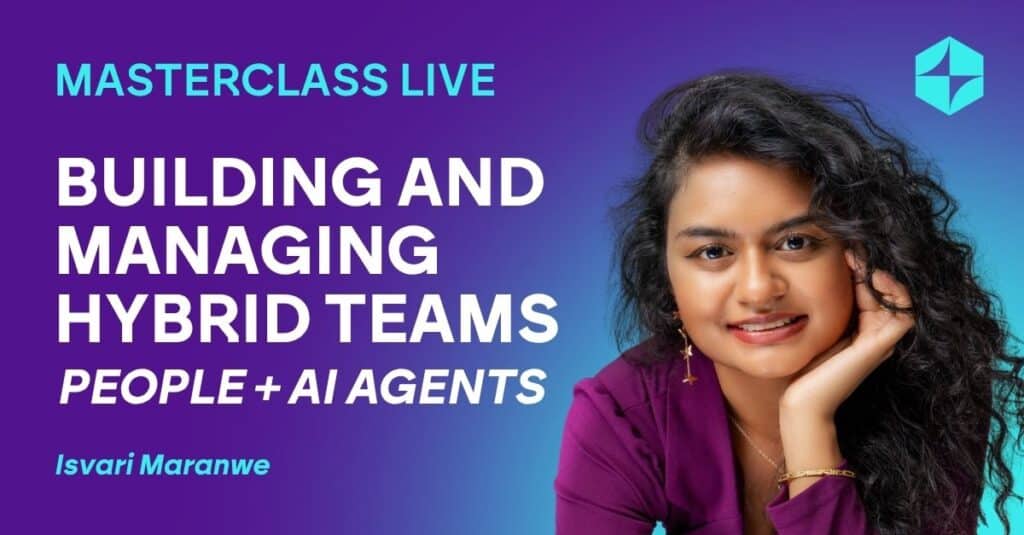
Most leaders are managing two workforces at once and only trained for one. There’s the team of people you know how to lead, you know how to set goals, review performance, and have the hard conversations. And then there’s a growing bench of AI agents doing real work inside your team, with no job description, no review process, and no one clearly accountable for what they do.
This masterclass is designed to bring together how you manage your Human + AI Agent teams. It takes the same management discipline you already use on people: role clarity, KPIs, oversight, performance review, succession planning, and shows you how to apply it to AI agents, so you’re running one coherent team instead of two separate systems that happen to sit next to each other.
Guided by Isvari Maranwe, CEO, attorney, AI ethicist, and one of the most-followed AI thought leaders working on real-world AI deployment, participants leave with a working model for their own team: which roles are people, which are agents, how the two collaborate, and how you’ll manage and govern the whole thing as it scales.
The course follows a deliberate arc. It begins with Reframe: moving from “AI as a tool my team uses” to “AI agents as members of my team, with a manager.” It moves into Design: mapping your team’s real workflow and deciding, role by role, what stays human, what becomes agentic, and where the two hand off to each other. Then Train: building the standards, data, prompts, tools, policies, voice that your whole team’s agents are held to, not just one person’s. Then Build: a hands-on session using Claude Code and Claude Cowork to stand up a working agent for a real team workflow. Then Govern: oversight at scale, escalation paths, red-teaming, and the accountability question every leader eventually has to answer, who signs off when an agent gets it wrong. The course closes with Implement: a rollout plan for your team and the operating rhythm that keeps a hybrid team healthy long after the course ends.
Every session works from your real team and your real workflows. By the end, you have a hybrid team model you designed yourself, at least one working agent built for a real piece of team work, and a governance and rollout plan ready to take back to your organisation.
Start Date: Coming Soon
Time: TBC
Session Duration: 90 mins x 9 weeks
Joining Details: Zoom link and calendar information sent on confirmation
Certificate provided at completion of all sessions
Attendees Limit: Min 15- Max 35
Before you can lead a hybrid team well, you need to see clearly that you already have one. Most leaders have AI agents doing real work somewhere in their team's process right now, drafting, summarising, triaging, coding, with none of the structure they'd insist on for a new hire.
We open by mapping your team as it actually runs today: which tasks are done by people, which are already touched by AI, and where the two overlap without anyone having decided it should work that way. Then we install the frame for the rest of the course: an AI agent on your team is a role with a mission, a scope, and limits, not a tool someone happens to be using.
We close with a frank look at where team leaders get this wrong: agents adopted ad hoc by individuals with no visibility for the manager, no consistency across the team, and no one accountable when something goes sideways. That's the gap this course exists to close.
The takeaway: If you lead a team, you're already managing agents, just without the structure. This course gives you that structure.
You wouldn't restructure a human team without a plan and this session is all about building that plan for a team that includes agents role by role, not tool by tool.
You'll work through your team's workflow and sort it into three categories: work that should stay firmly human (judgement calls, relationships, anything with real emotional or reputational weight), work that's ready to be agentic, and, the category most leaders skip, the handoff points where people and agents work the same task together. For every agentic role, you'll draft a role profile: mission and scope, responsibilities, limits, and who on the human team owns it.
You'll leave this session with a first-draft map of your team as a hybrid team, and a role profile for at least one agent in a real workflow.
The takeaway: A hybrid team isn't "people plus AI." It's a deliberately designed structure with clear ownership — and most teams don't have one yet.
Once you've mapped the hybrid team, you need to know if it's actually working, and be honest about what "working" means when an agent, not a person, is doing the task. We start with the question every leader has to answer before rolling this out further: is this genuinely freeing capacity, or just moving the work around?
Then we build the management layer: what KPIs apply to an agentic role versus a human one, how a team lead reviews an agent's output without micromanaging it, and when it's time to retire, retrain, or hand a piece of work back to a person. We'll also cover the trickiest part of hybrid team management, setting expectations for the humans working alongside agents, so oversight duties are clear and no one quietly absorbs the risk of an agent's mistake.
The takeaway: Every role on your team needs a KPI and an owner — agent or human. Skip this and you're managing on hope.
Individual AI use fails quietly, one prompt at a time. Team-wide AI use fails loudly, because inconsistency compounds across every person using it. This session covers the training stack — Data → Prompts → Tools → Policies → Voice — built as a team standard, not a personal habit.
We go deep on what changes at team scale: shared data standards so agents across the team are working from the same accurate information; prompt and tool standards so five people aren't building five inconsistent versions of the same agent; and policies that apply team-wide — the never-do list, escalation rules, and who has sign-off authority. We close with the rule every leader in this course has to enforce personally: the Final Voice rule. Anything with real emotional or reputational weight gets read, edited, and signed off by a person before it goes out — no exceptions, no matter how good the agent's draft is.
By Week 5 you've mapped your hybrid team and set the standards. This session is where one of those roles gets built. You don't need a technical background, most participants on this course aren't coders and you'll leave with a working mini-app, built live in Claude Code, that does a real piece of your team's work.
You bring a workflow from your own team's map; we build the agent for it together, with Isvari coaching. By the end you'll have something functional and yours - not a demo - plus a clear view of what changes for you as a manager once a piece of team work is handled by code rather than a person: new permissions to set, new audit trails to keep, new limits to define.
The takeaway: Building the agent is the easy part. Knowing what you, as the manager, now own is the part that matters.
Week 5 gave one workflow hands. Week 6 gives your team an assistant that runs in the background across several people's work — inbox triage, scheduling, status updates, the repetitive coordination that eats a team's time without anyone quite noticing.
We map where time leaks across the team, not just one person's day, and choose two or three tasks worth delegating collectively. Then we build the assistant together: what it should do unprompted, what it drafts and waits for sign-off on, and — critically for a shared assistant — whose sign-off, when more than one person could be affected.
We close with the management discipline a team-wide assistant demands: a shared audit log, a review habit that's someone's clear responsibility (not everyone's vague one), and a kill switch the whole team knows how to use.
The takeaway: A shared assistant without a clear owner isn't a team tool. It's a diffusion of responsibility waiting to cause a problem.
Managing one agent's performance is straightforward. Managing oversight across a whole team with multiple agents, multiple people, and multiple levels of risk is where most leaders haven't yet built the muscle. We start with the four levels of human review, L0 through L3, and how to assign the right level to each role on your team rather than applying one blanket rule to everything.
Then the governance layer a senior leader actually owns: escalation paths (who gets pulled in, and when), a red-teaming cadence for your team's highest-risk agentic roles, and how to run the performance loop — Test → Observe → Error Taxonomy → Fix → Retest — across a team instead of a single project.
We also cover the collaboration patterns your team will use day to day: Draft & Edit, Collaborator, and Orchestrator, and how to decide which pattern fits which role — plus what your people should be doing that the agents shouldn't: judgement under ambiguity, the moments that carry real emotional weight, and genuine creative direction.
The takeaway: Governance that depends on you personally reviewing everything doesn't scale. Governance built into the team structure does.
The last content session turns everything you've built into a rollout your organisation can actually sustain, anchored on a 30/60/90 day plan for your team.
First 30 days: finalise your hybrid team map and role profiles, agree the standards and sign-off rules, and put your first agentic roles into real use with close review. Days 30–60: assess what's working, decide which roles get expanded, retrained, or pulled back, and run a red-team week across your team's agents. Day 90 and beyond: a monthly operating rhythm — a review your team actually keeps to, honest feedback loops, and the habits that stop a hybrid team quietly drifting out of control.
We'll close with the four pitfalls specific to team-scale rollout: agents adopted individually with no team visibility, inconsistent standards across people doing the same job, unclear ownership when something goes wrong, and leaders who can talk about AI strategy but can't answer what their own team's agents did last month.
The takeaway: A well-designed hybrid team without an operating rhythm drifts back into the mess you started with — just with more moving parts.
This is where the course gets specific to your situation. First, present your favourite AI employee to the whole group. Then Isvari fields the real questions you have about what comes next.
Come with:
An AI employee you've designed and want feedback on.
A project that's stalling and you can't diagnose.
A compliance, legal, or ethics question you're wrestling with.
A specific tool, prompt, or framework that didn't translate to your context.
Anything that didn't make sense—or made too much sense—and needs interrogating.
This session is deliberately unstructured. It's where the most valuable learning tends to happen because the questions are real, the projects are live, and Isvari's answers are honest.


Browse other workshops in our catalogue that may be of interest:
AI is altering businesses, employees and individuals alike and it is paramount
What if AI didn’t make you less creative but it made you